
Quantum Credit Solutions — pull.credit, tri-merge credit for mortgage teams
Tri-merge credit, soft by default.
Tri-merge credit reports from Equifax, Experian and TransUnion, ordered as soft inquiries by default, from a portal or an API. Consent, permissible purpose and the audit trail are built into every order.
Demo
See it in two minutes.
A narrated walkthrough filmed in the live demo: a loan officer orders a soft pull and opens the merged report, the owner reviews oversight and billing, then hard-inquiry opt-in, the API and team roles.
Narrated, with captions. Filmed in the live demo with fictional people and data. 2:17 · 1080p
Read the transcript
- 0:00
- This is pull.credit. Tri-merge credit from Equifax, Experian, and TransUnion scored with FICO, ordered as a soft inquiry by default, and managed in one place for your whole team.
- 0:13
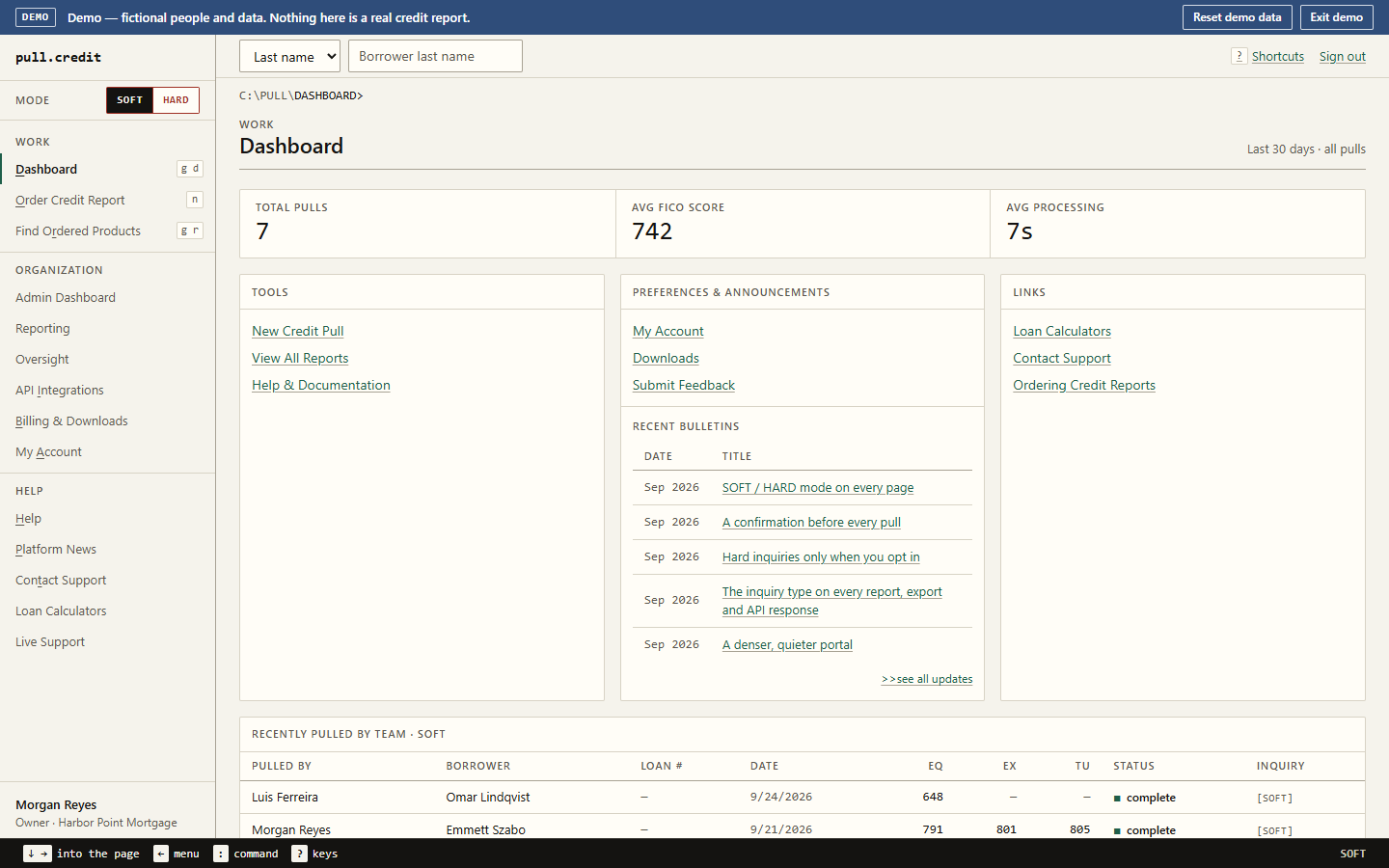
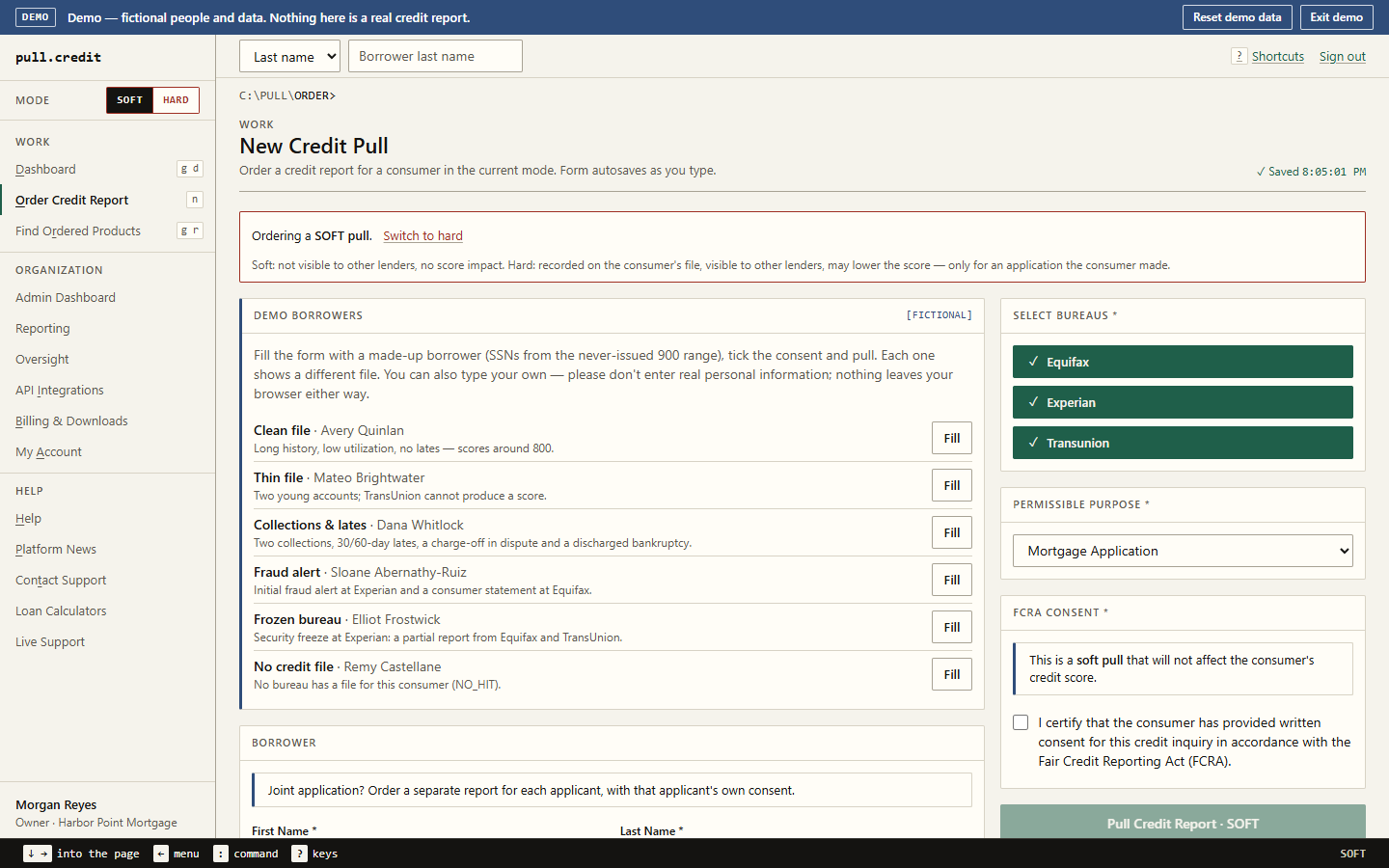
- For a loan officer, ordering takes a few clicks. The borrower, the bureaus, the permissible purpose, and the consumer's consent.
- 0:21
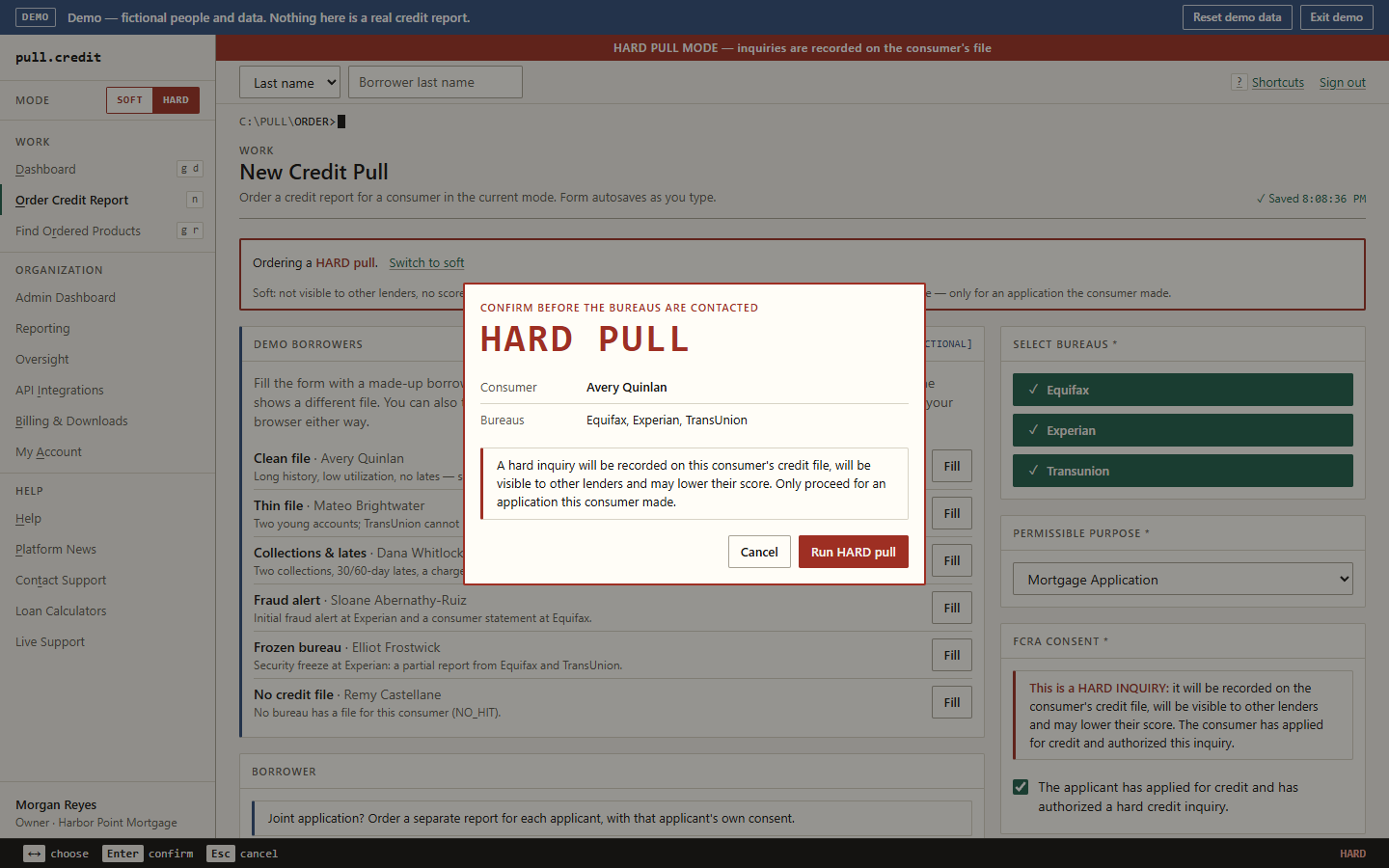
- Before anything is sent, a red confirmation names the inquiry type. A soft inquiry doesn't affect the consumer's scores and isn't visible to other lenders.
- 0:31
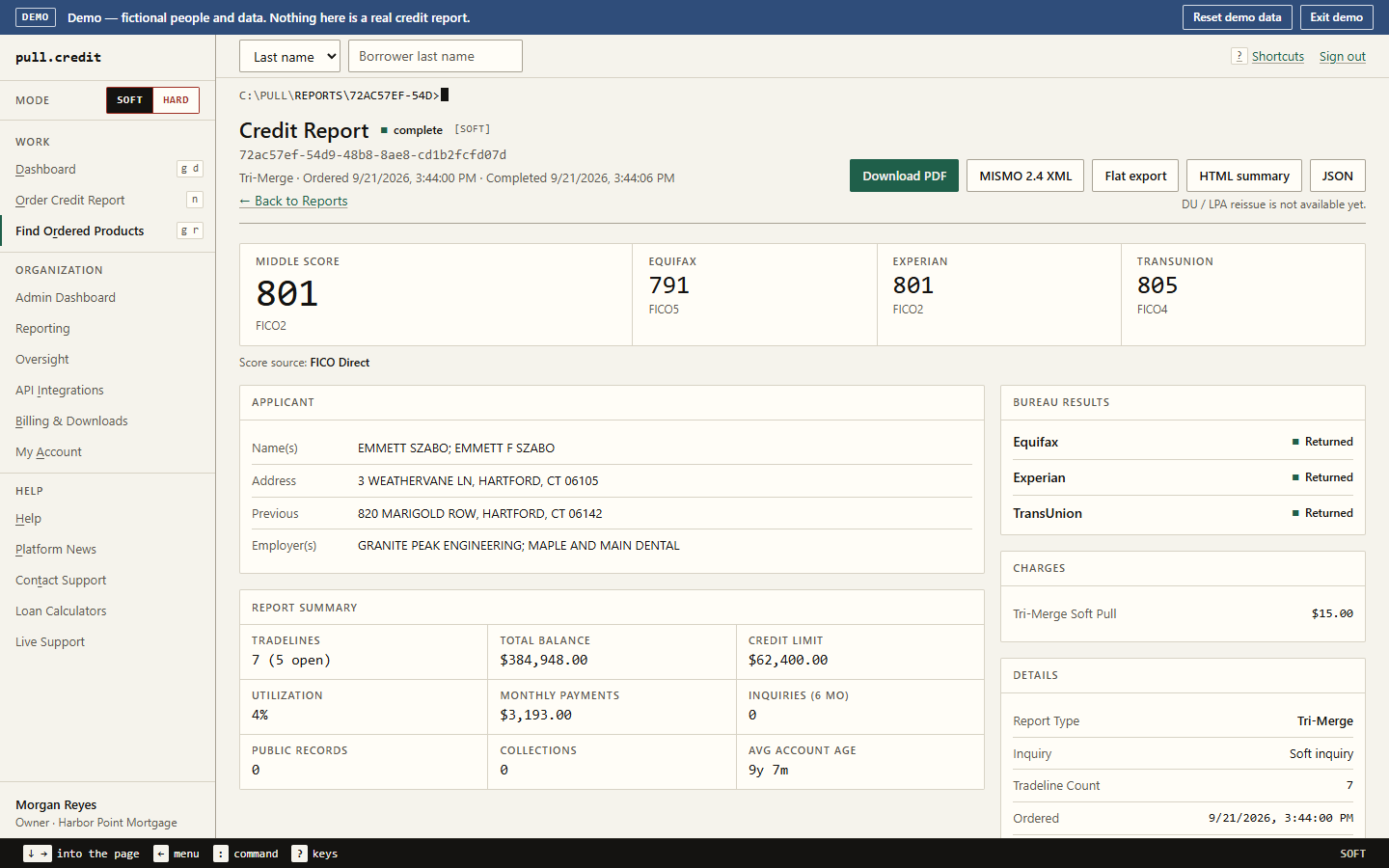
- The merged report opens with consumer alerts at the top, the score from each bureau, and every tradeline with the bureaus that reported it.
- 0:40
- The inquiry type is printed on the report and on every export. PDF, MISMO 2.4 XML, a flat file, HTML, and JSON.
- 0:50
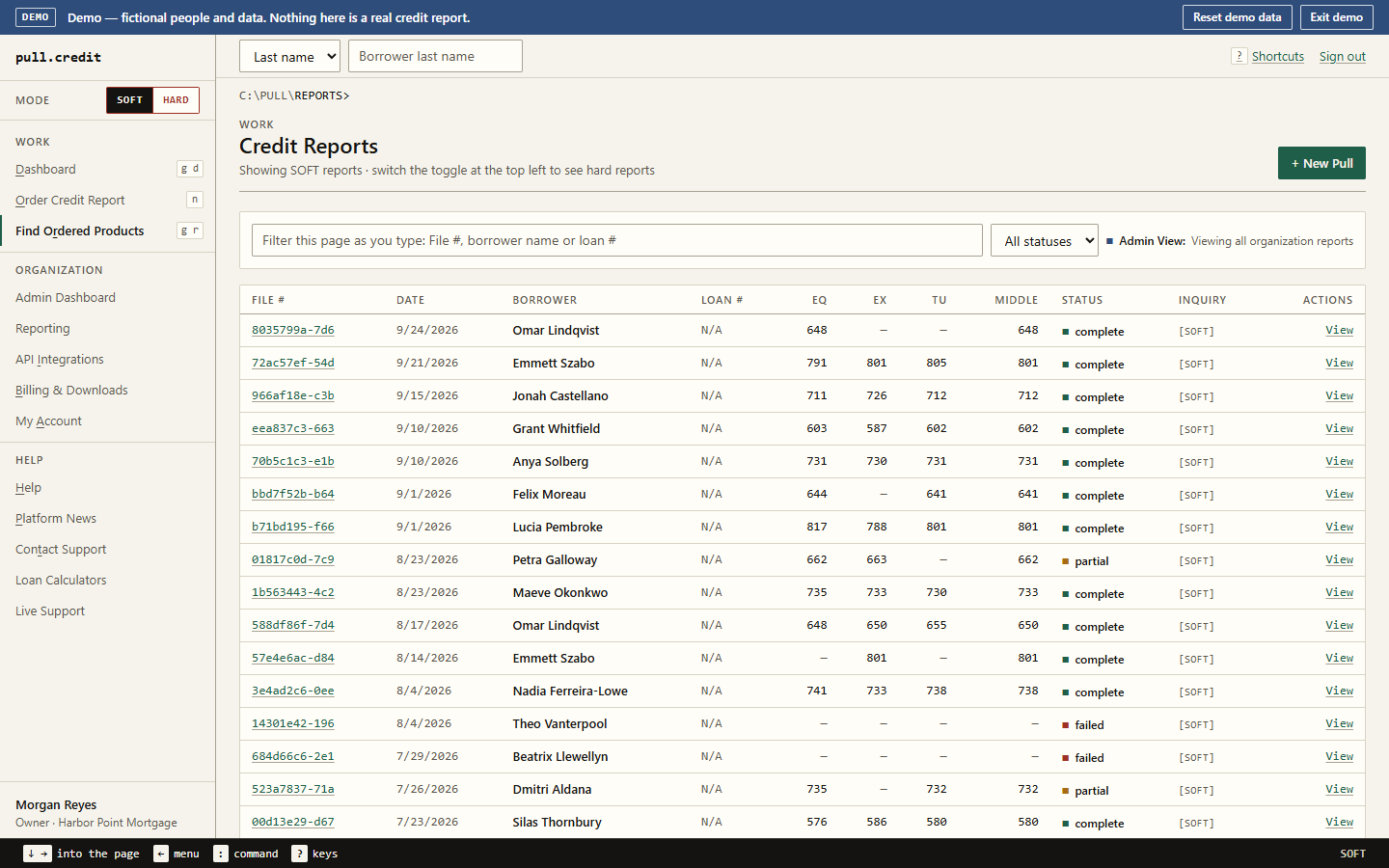
- Any file is a few keystrokes away, by last name or file number.
- 0:55
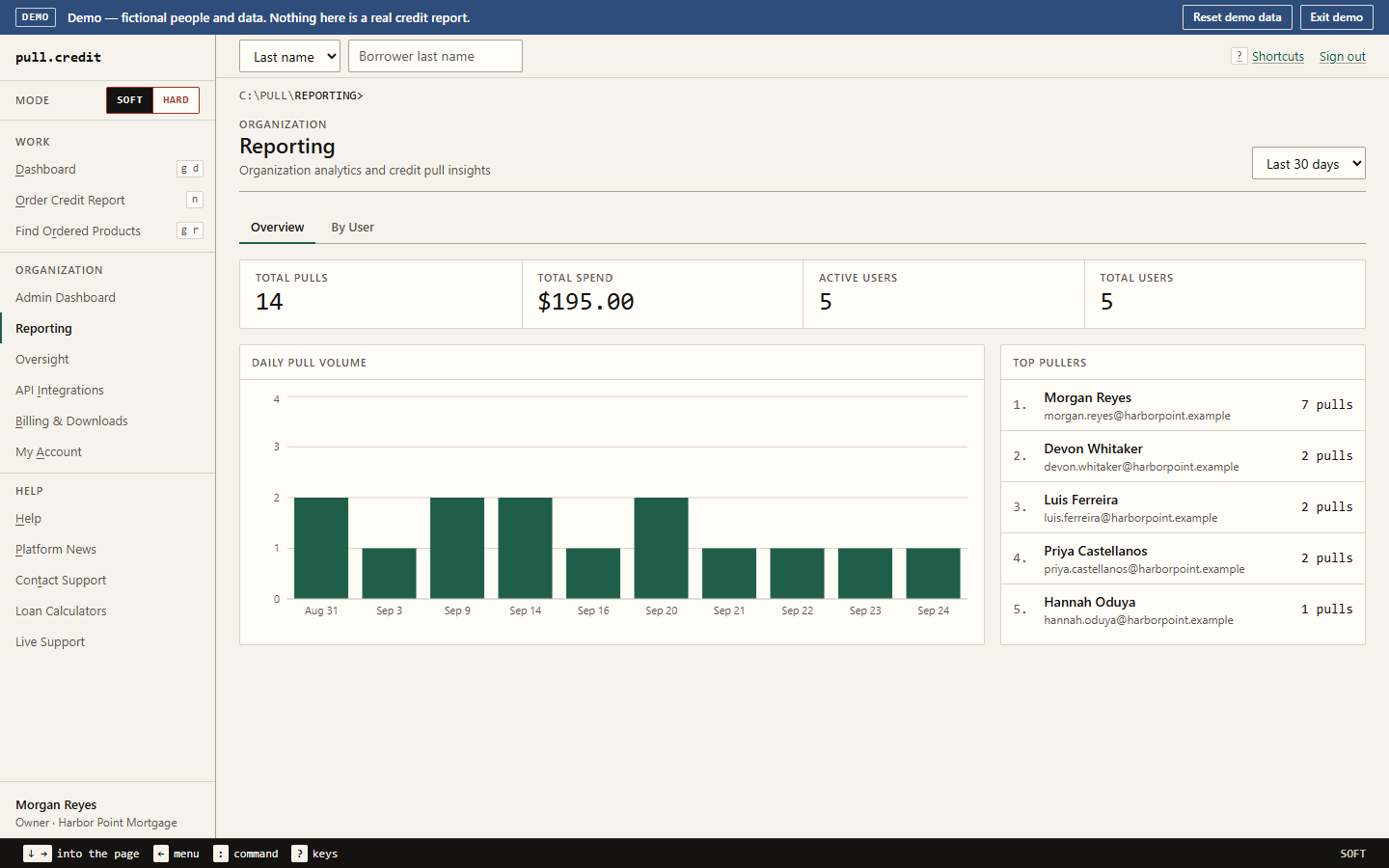
- Now the owner's view. Oversight shows what credit costs you, and why. Spend and the average cost per file for each loan officer; duplicate pulls of the same borrower, avoidable cost, and open compliance items. Every pull is written to an immutable audit log, who ordered it, the consent, the purpose, and the inquiry type.
- 1:16
- Billing and usage keeps the period's pulls, the current bill and every invoice in one place.
- 1:23
- Hard inquiries stay off until an owner or administrator opts your organization in. Then hard mode puts a red strip across every page, and a hard order needs a hard-inquiry consent, a credit application purpose, and a red confirmation. A hard inquiry is recorded on the consumer's file and may lower the score. A refused hard order is never quietly run as soft.
- 1:47
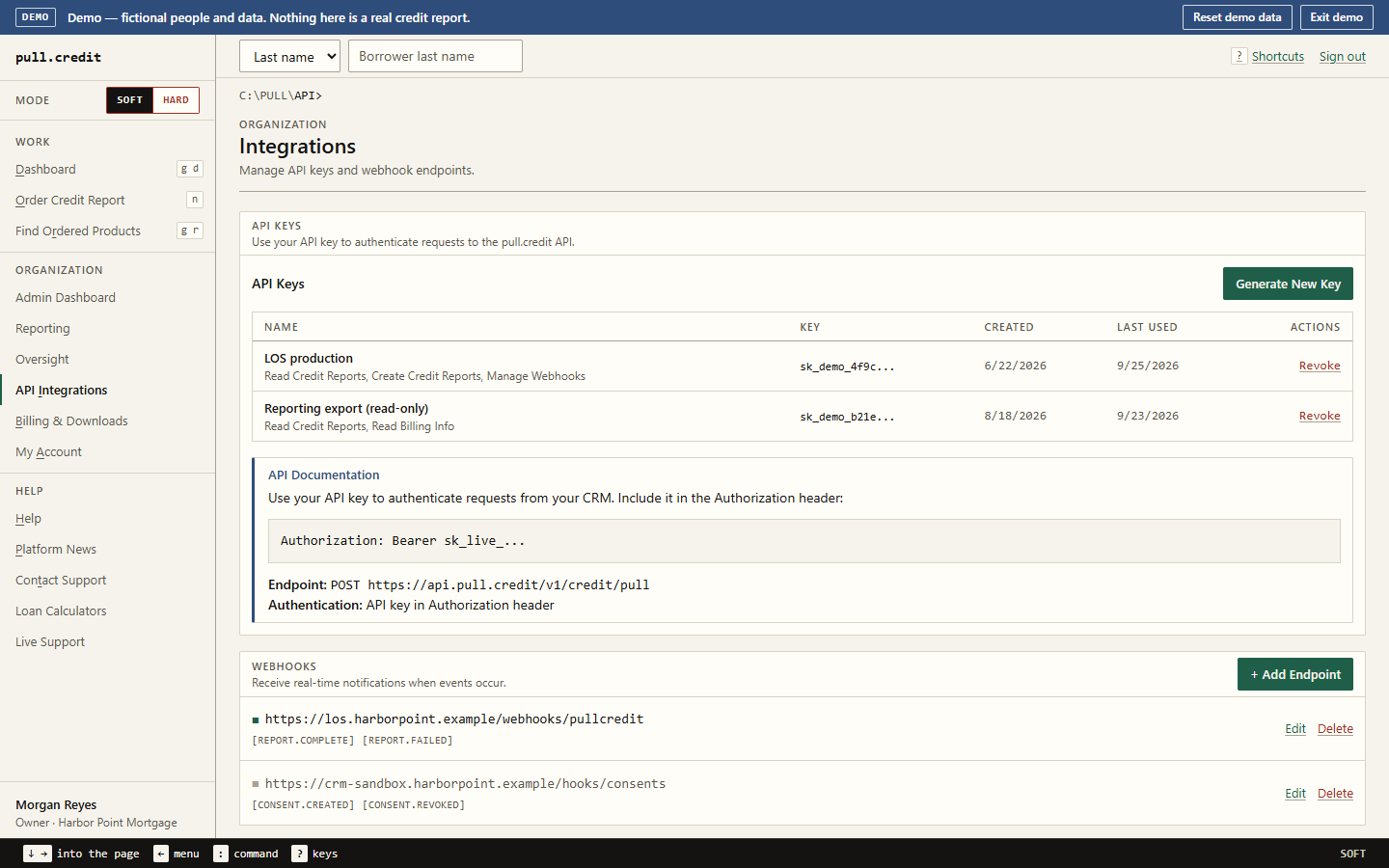
- And your systems can order, too, through the REST API, with scoped keys and signed webhooks, plus adapters for Encompass and LendingPad.
- 1:56
- Your team joins with invite codes that carry a role. Directors see every file and what it costs. Loan officers see only their own files, and never a cost.
- 2:07
- pull.credit. Tri-merge credit, soft by default. Explore the live demo at pull.credit/demo.
A look inside
The portal, from order to report.
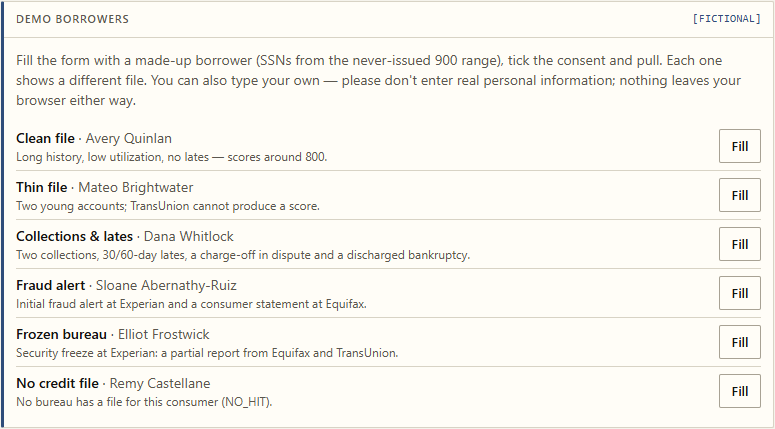
Screens from the live demo, which runs a sample brokerage with fictional people and data.
The problem
Ordering credit still means four tools and a lot of re-typing.
A credit report is the first thing a file needs and one of the last things that got modern tooling. Most teams work around it instead of with it.
Legacy resellers
Reports come through resellers whose pricing and contracts were set for a different era, and the cost lands on every file.
Re-keying
Ordering means typing the borrower into a second system, then carrying the result back to the LOS by hand.
Scattered evidence
Consent forms, permissible purpose, and who ordered what live in inboxes and folders, not with the pull they justify.
Two kinds of pull, two tools
Soft pre-qualification and hard underwriting pulls run through different systems, with different records of each.
Who it's for
Mortgage teams, and the systems they work in.
Brokers and lenders
Independent mortgage brokers and small-to-mid lenders: loan officers, processors, and owners who order credit every day and need the consent, purpose, and history kept with the report.
Integrators and CRM/LOS teams
Teams that embed credit ordering into their own systems, through a REST API with scoped keys, asynchronous ordering, signed webhooks, and a published OpenAPI document.
What it does
Six core capabilities
01

Tri-merge, scored with FICO
Reports from Equifax, Experian and TransUnion, or a single bureau when that's all a file needs. Bureau responses are merged with conflict rules and tradeline matching, and scored with FICO.
02
Soft by default, hard by choice
Every order is a soft inquiry unless hard is explicitly chosen. The inquiry type is stored on the pull, sent to every bureau, audited, and printed on every report and export.
03
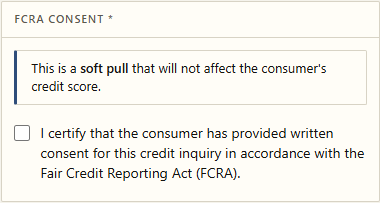
Consent and purpose on every order
Each pull is bound to the consented borrower and to the consent's permissible purpose, so the evidence sits with the report rather than in an inbox.
04

Exports your systems already read
PDF, MISMO 2.4 XML, a pipe-delimited flat file, HTML, and JSON, with the inquiry type printed on each.
05
A portal for the whole team
Dashboard, order form, report list and detail. Roles for owner, administrator, manager, and loan officer, with invite codes. API keys, webhooks, billing and usage in one place.
06
An API built for integration
REST API with scoped keys, asynchronous ordering with status polling, signed webhooks, and a published OpenAPI 3.0 document.
How it works
From consent to report in four steps.
Capture consent
Record the borrower's consent and the permissible purpose. The pull that follows is bound to both.
Order the tri-merge
Order a soft tri-merge from the portal or the API. Where hard inquiries are enabled, choose hard on purpose and confirm it.
Merge and score
Responses from the three bureaus are merged with conflict rules and tradeline matching, then scored with FICO.
Read, export, or sync
Read the report in the portal, export it in the format your systems take, or have it delivered to your CRM by webhook.
Inquiry type
Soft and hard, on purpose.
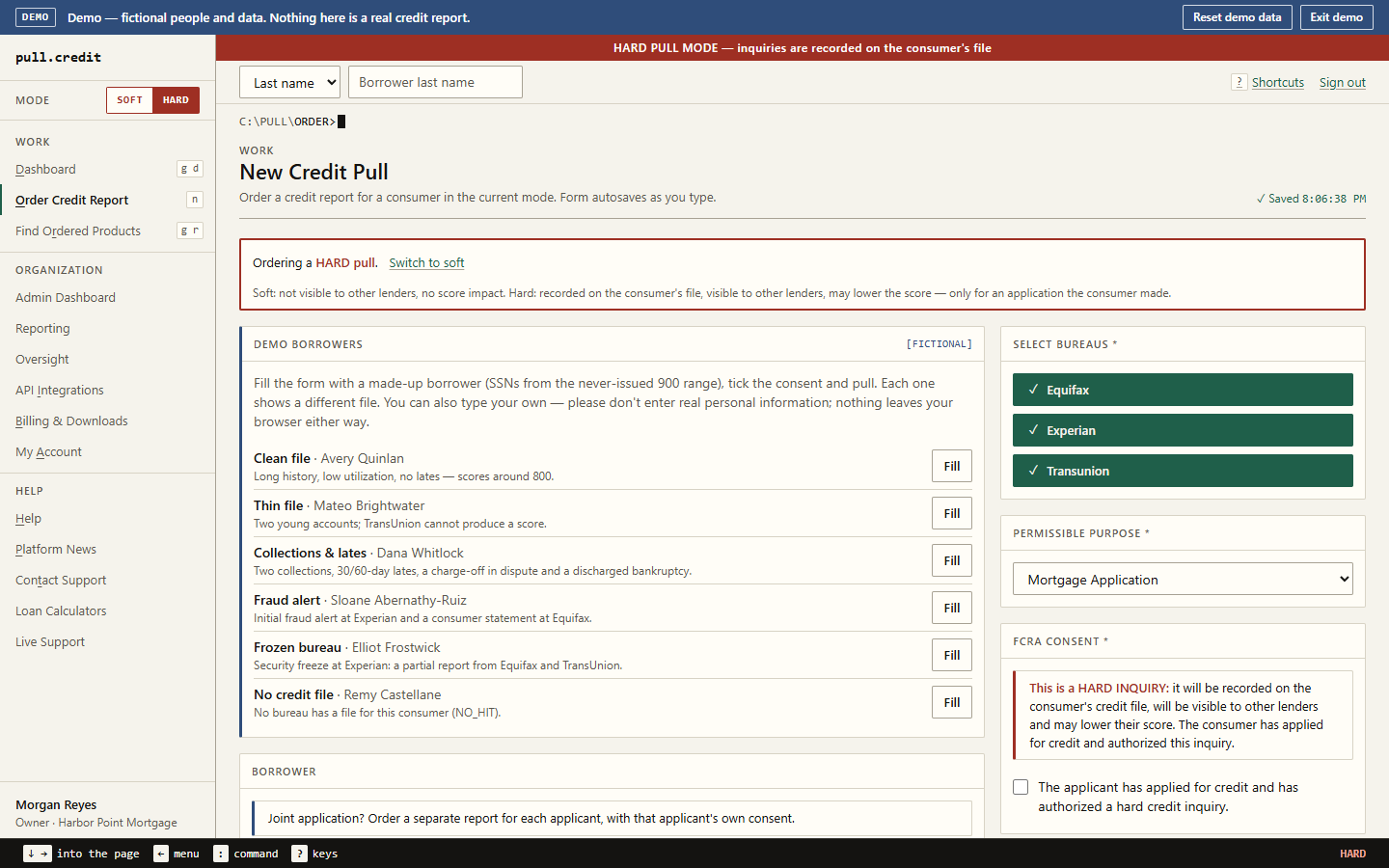
Every order is soft unless hard is explicitly chosen. Turning hard inquiries on takes an organisation opt-in, a dedicated permission, a hard-inquiry consent from the borrower, and a credit-application purpose.
The portal shows the current mode in red and asks for confirmation before every pull. A hard order that doesn't meet those conditions is refused; it is never silently downgraded to soft.
Soft The default
- Not visible to other lenders
- Does not affect the borrower's scores
- Requires the consumer's consent and a permissible purpose
Hard Opt-in only
- Recorded on the borrower's file and may lower the score
- Needs a hard-inquiry consent and a credit-application purpose
- Confirmed in the portal before every pull
Compliance and security
Built to support FCRA workflows.
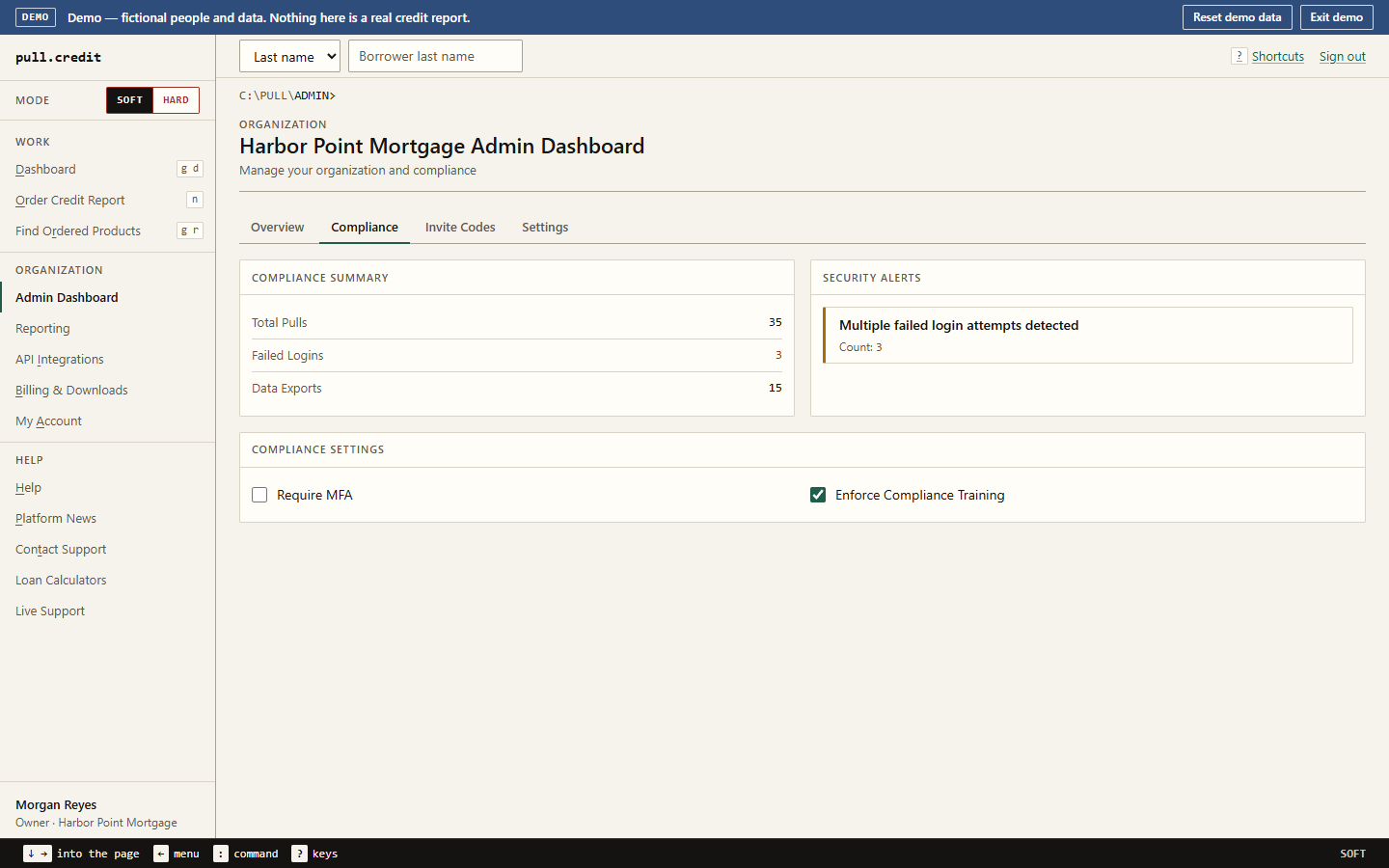
The paperwork around a credit pull is part of the product, not a folder next to it.
FCRA workflows
- Permissible purpose recorded on every pull (§604)
- Reseller end-user identification (§607(e))
- The §607(d) notice to users
- Consumer file disclosure (§609)
- Dispute intake with §611 deadlines and forwarding
- Adverse-action notices (§615(a))
- Data-subject deletion requests
- Retention policies
Security
- Consumer PII (SSN, date of birth) and credit data encrypted at rest with AES-256-GCM
- Key rotation, with optional AWS KMS envelope encryption
- An immutable audit log of credit operations
- Two-factor authentication (TOTP), enforceable per organisation
- Revocable sessions
- Rate limiting
- TLS in transit
Integrations
Into the systems you already run.
LOS adapters
Encompass and LendingPad adapters are implemented. LodaSoftplanned, Calyxplanned, ByteProplanned and Salesforceplanned are on the roadmap.
Universal webhook
A signed webhook adapter delivers completed reports to any system that can receive an HTTP call, with the signature to verify it came from pull.credit.
REST API
Scoped API keys, asynchronous ordering with status polling, and a published OpenAPI 3.0 document to build against.
FAQ
Frequently asked questions
What is the difference between a soft and a hard pull?
A soft inquiry is not visible to other lenders and does not affect the borrower's scores. A hard inquiry is recorded on the borrower's file and may lower the score. pull.credit orders soft by default; hard is an explicit, opt-in choice.
Do I need the borrower's consent?
Yes. Every order requires the consumer's consent and a permissible purpose, and the pull is bound to both. A hard inquiry additionally needs a hard-inquiry consent and a credit-application purpose.
Which bureaus?
Equifax, Experian and TransUnion, as a tri-merge or as a single-bureau order. Reports are scored with FICO.
Which formats can I export?
PDF, MISMO 2.4 XML, a pipe-delimited flat file, HTML and JSON.
Does it work with my LOS?
Encompass and LendingPad adapters are implemented today, and a universal signed webhook reaches anything else that can take an HTTP call. LodaSoft, Calyx, BytePro and Salesforce are planned. The REST API and OpenAPI document are there for anything custom.
Can I try it?
Yes. The live demo opens the portal as a sample brokerage with fictional borrowers and reports. You can order soft and hard pulls and read the results; nothing leaves your browser.
Where is data stored and how is it protected?
Consumer PII and credit data are encrypted at rest with AES-256-GCM, with key rotation and optional AWS KMS envelope encryption, and TLS in transit. Every credit operation is written to an immutable audit log, two-factor authentication can be enforced per organisation, and sessions can be revoked.
Get started
See it with fictional data in two minutes.
The demo opens the portal with made-up borrowers and reports. Nothing leaves your browser.